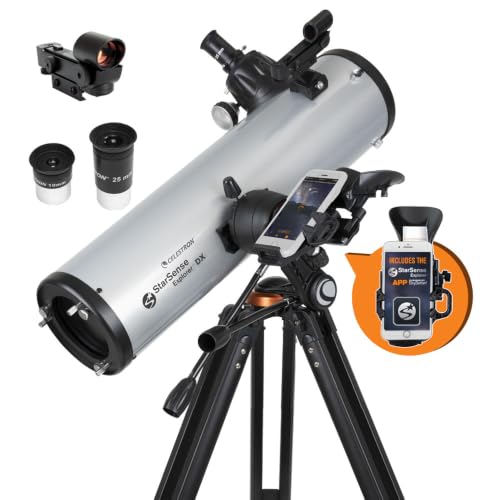
The Celestron StarSense Explorer DX 130AZ is a 130 mm (5 inch) Newtonian reflector on a manual alt-azimuth mount, with a twist: your smartphone acts as the finder. It is built to answer the question that stops most new telescope owners, which is how to find anything. It is not computerized and it does not track for you, but it tells you where to point.
We compared the specifications from Celestron’s own product page and organized them below. We have not handled the telescope ourselves, and we do not describe observations we have not made.
Who the StarSense Explorer DX 130AZ Is For
This telescope makes the most sense for:
Adults buying a first serious telescope. A 5-inch aperture is a big step up from the 70 mm to 90 mm scopes sold in department stores, and the app removes much of the early frustration of finding things.
Families and groups who want to share the view. A manual telescope with an app is easy to hand around: one person moves the tube following the arrows, and when the bullseye turns green the next person looks in. Celestron states no minimum age for the telescope, and notes that an adult familiar with the correct operating procedures should be with the optic at all times, especially when children are present.
People who want something between a basic scope and a GoTo. If a motorized, computerized mount feels like too much cost and complexity, but you still want guidance, this fills the gap.
It is a weaker fit for anyone who wants automatic tracking for long viewing sessions or for imaging, and for anyone who does not want to use a phone at the telescope.
Key Specs
| Spec | Value | Source |
|---|
| Optical design | Newtonian reflector, parabolic primary mirror | Celestron |
| Aperture | 130 mm (5.11 inches) | Celestron |
| Focal length / ratio | 650 mm (25.59 inches), f/5 | Celestron |
| Eyepieces | 25 mm (26x) and 10 mm (65x) | Celestron |
| Finderscope | StarPointer red-dot | Celestron |
| Limiting stellar magnitude | 13.1 | Celestron |
| Light gathering power | 345x the human eye | Celestron |
| Highest / lowest useful magnification | 307x / 19x | Celestron |
| Resolution (Dawes) | 0.89 arcseconds | Celestron |
| Secondary obstruction | 45 mm (34 percent by diameter, 11 percent by area) | Celestron |
| Mount | Manual alt-azimuth with slow-motion controls | Celestron |
| Optical tube weight / length | 8.8 lbs (3.99 kg) / 25 inches (635 mm) | Celestron |
| Tripod weight | 9.2 lbs (4.17 kg) | Celestron |
| Total kit weight | 18 lbs (8.16 kg) | Celestron |
| Maximum tripod height | 49 inches | Celestron |
| Power | None required | Celestron |
| Warranty / returns | 2 years / 30 days | Celestron |
Optics and What You Can Realistically See
A 130 mm aperture collects about 345 times as much light as the unaided eye, according to Celestron. That puts the telescope in the middle of the range for a beginner instrument: much more capable than a 70 mm refractor, and well short of an 8-inch Dobsonian.
Celestron describes what to expect: sharp, bright views of Jupiter’s four Galilean moons, its cloud bands and Great Red Spot, the rings of Saturn, the Trapezium in the Orion Nebula and the Pleiades open cluster. Those are standard targets for a telescope of this size, and they match what we would expect from a 5-inch reflector. Under darker skies, Celestron says the Andromeda Galaxy and Hercules cluster are within reach.
Some realism helps. Galaxies and nebulae appear as gray smudges to the eye through any telescope this size; the color in photographs comes from long exposures. Under a bright sky they are fainter still. The Moon and planets are the dependable targets from town, which Celestron’s own wording about city viewing confirms.
The focal ratio is f/5, and the two included eyepieces give 26x and 65x. The 25 mm eyepiece is the one for finding things and for wide objects like star clusters. The 65x view is for the Moon, planets and double stars. Celestron’s page notes that no Barlow lens is included, and the highest useful magnification is listed at 307x, so there is room above the 65x that you get in the box. A higher-power eyepiece or a 2x Barlow is a sensible first upgrade.
As with any Newtonian, the mirrors can drift out of alignment, which is called collimation. Celestron’s product page does not describe a collimation procedure, so check the manual.
Mount and Finding Objects
The mount is a manual alt-azimuth with slip clutches and geared slow-motion controls on both axes, according to Celestron. Because objects drift across the sky, you follow them by turning the slow-motion knobs. There is no motor.
The process with the app is as follows, per Celestron: put your phone in the dock, launch the app, align the phone to the telescope’s optics (about 2 minutes), pick a target from the list of objects currently visible, and move the telescope until the bullseye turns green. The app uses the phone’s camera and GPS and compares star patterns to its database, instead of relying only on the phone’s gyroscope and accelerometer.
You need a view of enough stars for the app to recognize. Heavy cloud or very bright surroundings will make that harder. If the app does not suit you, the red-dot finder and a star chart still work.
Setup, Weight and Portability
The kit weighs 18 lbs (8.16 kg) in total, according to Celestron, with an 8.8 lb (3.99 kg) tube and a 9.2 lb (4.17 kg) tripod. The mount and tripod arrive pre-assembled. For an adult, that is a one-trip carry to a yard or a car trunk. The tube is 25 inches long, so check your storage and car space.
With no power required, the only battery to think about is the one in your phone. Cold weather drains phone batteries quickly, which is why Celestron recommends a PowerTank Glow.
What’s in the Box and What You’ll Want to Add
According to Celestron, the box includes the optical tube, a pre-assembled mount and tripod, 25 mm and 10 mm eyepieces, the StarPointer finderscope, an accessory tray and the StarSense phone dock. The software package is the StarSense Explorer app, the SkyPortal app and Starry Night Basic Edition.
Worth adding:
- A higher-power eyepiece or a Barlow lens, for planets and the Moon.
- A power bank for your phone, which Celestron itself recommends.
- A Moon filter, which Celestron sells and which cuts glare at low power.
- A red flashlight to protect night vision when reading charts.
On solar viewing: never look at the Sun with any telescope without the proper solar filter, and never use the optic to project the Sun’s image onto a surface. Celestron lists an EclipSmart solar filter for this model and warns about permanent eye damage.
Alternatives on This Site
If you want a smaller, lighter, lower-effort option with the same brand behind it, the Celestron Inspire 100AZ is a short 100 mm refractor with an integrated phone adapter and a lighter 12.4 lb kit. It has less aperture and no app guidance of this kind.
If you want the sky found and tracked for you, a different category fits better, such as the Unistellar Odyssey, which has motorized GoTo and shows its image on your phone or tablet, with no eyepiece.
Who Should Skip It
Skip it if you want motorized tracking, if you plan to do astrophotography beyond phone snapshots, or if you do not want to hold a phone at the telescope. If you already know the sky, a simple Dobsonian will typically give you more aperture for the money.
Verdict
The StarSense Explorer DX 130AZ makes a traditional telescope less intimidating. You get a real 5-inch aperture, an eyepiece view and a straightforward manual mount, with an app that helps you point where you want to look. The limits are plain: you move the telescope yourself, the included eyepieces cover a narrow range, and the app depends on your phone. For adults and families who want to start with real optics and a guided approach, it is a solid choice. See how it ranks against the other nine models in our best telescopes of 2026 comparison.
See price on Amazon
Sources