We earn a commission if you buy through our links, at no extra cost to you.
Comparison
Best Telescopes of 2026: 10 Models Compared
We compared the maker specs of 10 telescopes for 2026, from 8-inch Dobsonians to smart telescopes, and ranked them by who each one suits.
B By the Best Telescopes Guide editorial team ·Published
At a glance
Most adults should start with the Celestron StarSense Explorer 8" Dobsonian: an 8-inch mirror with phone-guided finding on a manual mount. The Celestron NexStar 8SE adds GoTo tracking, the Seestar S50 Pro is a portable smart telescope for phone photos, and the Sky-Watcher Classic 200P Dobsonian is a no-electronics 8-inch for star-hoppers.
A telescope is one of the few purchases where the biggest, most expensive option is not automatically the right one. The best scope is the one you will actually carry outside on a Tuesday night. This year’s choices also include a new kind of product, the smart telescope, which finds objects, tracks them and shows you a stacked image on your phone. We did not handle any of these telescopes. We compared the specifications published by Celestron, Sky-Watcher, Seestar, Unistellar and DwarfLab, read the sources listed at the end, and ranked ten models by who each one suits.
How We Chose
Five questions sort the field quickly.
Aperture. The width of the mirror or lens sets how much light the telescope gathers and how much detail it can show. Eight inches (203 mm) is the size many hobbyists settle on for good. Four inches is a fine start for the Moon and planets.
Mount and finding. A manual Dobsonian costs less per inch of aperture but asks you to push the tube. A computerized GoTo mount finds and tracks for you but needs power. A smart telescope does everything through an app.
Eyepiece or screen. Traditional scopes put your eye to the sky. Smart telescopes show a camera image on a phone, which suits cities and photos but is a different experience.
Weight and storage. A 43 lb scope that stays in the closet gets used less than a 6 lb one. We list weights only where the maker states them.
What the maker leaves out. Some pages skip weight, eyepieces or warranty. We flag those gaps instead of filling them in.
We use maker figures throughout. Ranking is by fit for the typical adult buyer, so the order is not a measure of optical quality.
Comparison Table
#
Model
Type
Aperture
Mount / finding
Weight (per maker)
1
Celestron StarSense Explorer 8” Dobsonian
Newtonian reflector
203 mm (8 in.)
Manual Dobsonian, phone-app guidance
43.4 lbs total
2
Celestron NexStar 8SE
Schmidt-Cassegrain
203.2 mm (8 in.)
Computerized GoTo fork mount
32 lbs total
3
Seestar S50 Pro
Smart telescope
50 mm
Motorized alt-az, EQ mode, app control
About 6.2 lbs (2.8 kg), main unit
4
Sky-Watcher Classic 200P Dobsonian
Newtonian reflector
200 mm (8 in.)
Manual Dobsonian, 9x50 finderscope
n/a
5
Celestron NexStar 6SE
Schmidt-Cassegrain
150 mm (5.91 in.)
Computerized GoTo fork mount
28 lbs total
6
Unistellar Odyssey
Smart telescope
85 mm
Motorized GoTo, autofocus, app control
8.8 lbs telescope, plus 5.5 lbs tripod
7
DwarfLab DWARF 3
Smart telescope
35 mm (telephoto)
Motorized GoTo, AZ/EQ modes, app control
About 3 lbs (1.35 kg)
8
Celestron StarSense Explorer DX 130AZ
Newtonian reflector
130 mm (5.11 in.)
Manual alt-az, phone-app guidance
18 lbs total
9
Sky-Watcher Heritage 150 Tabletop Dobsonian
Newtonian reflector
150 mm (about 6 in.)
Manual tabletop Dobsonian
n/a
10
Celestron Inspire 100AZ
Refractor
100 mm (3.94 in.)
Manual alt-az on a steel tripod
12.4 lbs total
Smart telescopes (3, 6, 7) are not directly comparable to the others on aperture, because they gather light with a sensor and stack many frames rather than relying on the mirror size alone.
1. Celestron StarSense Explorer 8” Dobsonian — The Top Pick for Most Adults
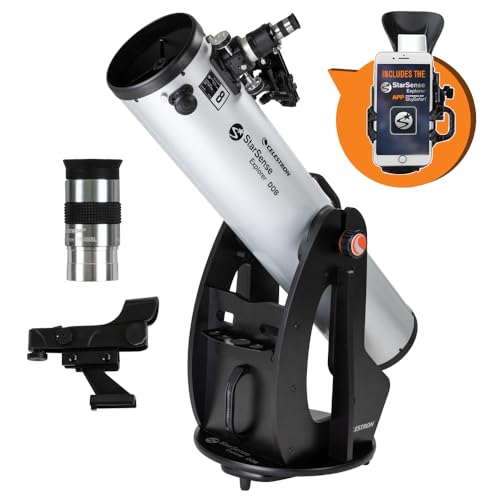
According to Celestron, this telescope pairs a 203 mm (8-inch) Newtonian mirror, f/5.9, with a manual Dobsonian base and the StarSense Explorer app. You dock your phone on the tube, the app uses the phone camera to recognize star patterns, and on-screen arrows walk you to the target until a bullseye turns green. There are no motors, no power cord and no alignment routine to memorize. Celestron lists a 2-inch Crayford focuser, a 25 mm eyepiece (48x) and a StarPointer red-dot finderscope in the box.
It takes first place because it combines the two things beginners most often lack: enough aperture that the views do not feel limiting in a year, and a way to find objects without learning a star chart first. Celestron states a limiting magnitude of 14.2 for the aperture, a theoretical figure that depends on your sky.
The trade-off is size. Celestron lists 43.4 lbs in total, split into a 20.6 lb tube and a 22.8 lb base. Plan on a garage, shed or ground-floor closet, and expect to collimate the mirrors occasionally. If you can live with that, this is the one we would point most adults toward. See the StarSense Explorer 8-inch Dobsonian profile for the full specs.
2. Celestron NexStar 8SE — The Computerized 8-Inch
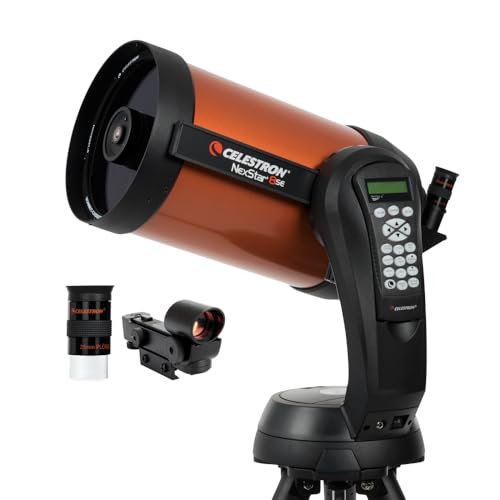
The NexStar 8SE puts the same 203.2 mm aperture into a folded Schmidt-Cassegrain tube on a computerized single-fork mount. According to Celestron, it has SkyAlign and 2-star alignment, a 40,000-object database on the NexStar+ hand control, SkyPortal app software, and a 25 mm eyepiece giving 81x. The focal length is 2032 mm at f/10, which favors planets, the Moon and small deep-sky targets over wide, sweeping star fields.
Its strength is automation. After alignment, the mount slews to any object in the database and tracks it, so you can spend a session looking instead of searching. The optical tube is 12 lbs, which Celestron lists within a 32 lb kit including a 9 lb tripod and 11 lb mount head. It needs power: 8 AA batteries (not included) or a 12 VDC supply.
It ranks second because it sits higher in the price range and asks more of you than the Dobsonian in first place. The extra cost buys tracking, a compact tube and a platform that can grow with accessories. Read more in the NexStar 8SE profile.
The Seestar S50 Pro is a different kind of instrument. According to Seestar, it has a 50 mm aperture with a 260 mm focal length at f/5.2, a four-element apochromatic lens with ED glass, an 8.3 MP telephoto sensor and a second wide-angle camera. It sits on an alt-azimuth mount that also supports an equatorial mode, with a tripod included. You control it from the Seestar app over Wi-Fi, Bluetooth or USB-C.
The appeal is simplicity and photos. You set it down, tell the app what you want, and it points, tracks and stacks frames into a picture that appears on your phone. Seestar lists a 10,000 mAh battery rated up to 9 hours in ZWO’s lab data, 128 GB of storage (about 100 GB usable) and a main unit of about 6.2 lbs (2.8 kg), with a protective case and a solar filter in the package. Use the solar filter only as Seestar instructs, and never point any telescope at the Sun without a certified filter.
It ranks third because it fills a need the others cannot: deep-sky pictures without a learning curve. The trade-off is that there is no eyepiece, and the 50 mm aperture is small. See the Seestar S50 Pro profile.
4. Sky-Watcher Classic 200P Dobsonian — The Traditional 8-Inch
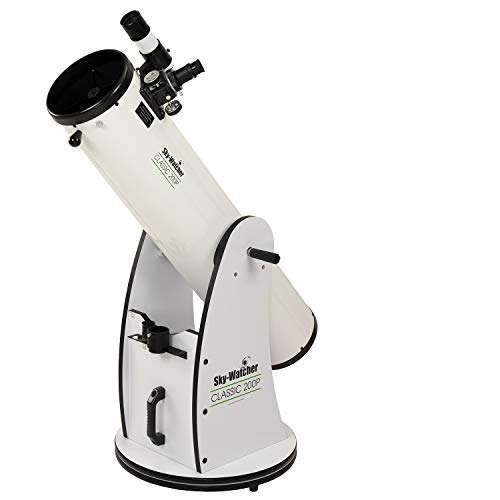
The Classic 200P is the simplest way to get 8 inches of aperture. According to Sky-Watcher USA, it has a 200 mm parabolic primary mirror with a borosilicate substrate and a 94 percent reflective coating, a manual rocker box with Teflon bearings and a tension control handle, and a 2-inch Crayford-style focuser with a 1.25-inch adapter. The kit includes two 1.25-inch eyepieces and a 9x50 finderscope. Sky-Watcher says it is 78 percent brighter than its own 150 mm model.
There is no GoTo, no app and no electronics. You find objects by star-hopping with a chart or app and a finderscope, which is a skill but also a pleasure for many observers. That makes it a fine second scope for someone who has outgrown a small starter model, and a solid first one for a patient beginner.
Sky-Watcher’s page does not list weight or focal length, so confirm both before you buy eyepieces. It ranks fourth because the StarSense model in first place gives you the same aperture plus a way to find things. See the Classic 200P profile.
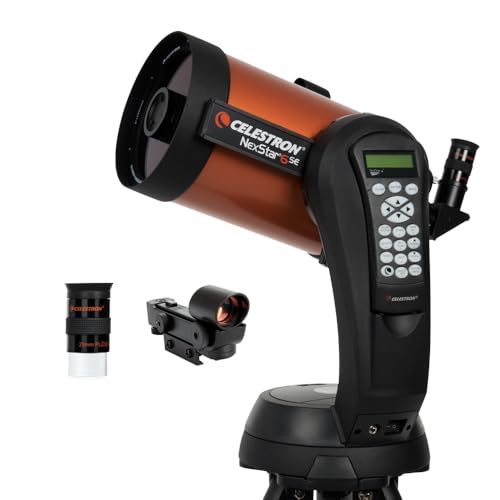
The NexStar 6SE takes the 8SE formula and shrinks it. According to Celestron, it has a 150 mm (5.91 inch) Schmidt-Cassegrain tube at f/10 and 1500 mm focal length on the same style of computerized fork mount, with SkyAlign, the 40,000-object database, SkyPortal and a 25 mm eyepiece giving 60x. The total kit is 28 lbs, with an 8 lb tube.
For many buyers this is the sweet spot of GoTo: a mount that finds and tracks, a tube small enough to store easily, and optics that handle the Moon, planets and brighter deep-sky objects well. Power comes from 8 AA batteries or a 12 VDC supply, neither of which is included.
It ranks fifth because you give up two inches of aperture compared with the 8SE in exchange for a modest weight savings, and the models above it deliver more light with less effort. Choose it if portability matters more than the last bit of faint-object performance. See the NexStar 6SE profile.
6. Unistellar Odyssey — The City-Friendly Smart Telescope
The Unistellar Odyssey is a smart telescope with an 85 mm mirror, a 320 mm focal length at f/3.9, motorized GoTo and automatic focus. According to Unistellar, you watch the live image on a phone or tablet over Wi-Fi, since the standard Odyssey has no eyepiece. It lists a telescope weight of 8.8 lbs (4 kg), a 5.5 lb (2.5 kg) tripod in the box, a 5-hour battery, 64 GB of storage and a limiting magnitude of 17.2.
Its appeal is simple: live image stacking pulls nebulae and clusters out of suburban skies, and it requires almost no setup knowledge. Unistellar says up to 10 people can follow the live view at once, which makes it a good choice for a family or a small group.
It ranks sixth because it is less flexible than a traditional scope for planets, and because the tripod is Unistellar’s own design. If seeing through an eyepiece matters to you, look higher on this list. See the Unistellar Odyssey profile.
7. DwarfLab DWARF 3 — The Pocket Astrophotography Camera
The DWARF 3 is the smallest instrument here. According to DwarfLab, it has a 35 mm telephoto aperture with a 150 mm focal length, a 1/1.8-inch Sony IMX678 sensor, a wide-angle camera and a six-element apochromatic lens group. It adds built-in VIS, astro and dual-band filters, 60-second maximum exposures, AZ and EQ modes, 128 GB of storage and a weight of about 3 lbs (1.35 kg). The package includes a storage bag and a magnetic solar filter. Use the filter as DwarfLab instructs, and never observe the Sun without a certified filter.
Its tiny size and app automation make it a good travel companion. The tripod is sold separately, so budget for one. DwarfLab’s page also states slightly different battery figures in different places, roughly five to five and a half hours.
It ranks seventh because the aperture is small and the system is built for taking pictures, not for looking. For a beginner who wants to try astrophotography, that is exactly the point. See the DWARF 3 profile.
8. Celestron StarSense Explorer DX 130AZ — The Smaller Phone-Guided Reflector
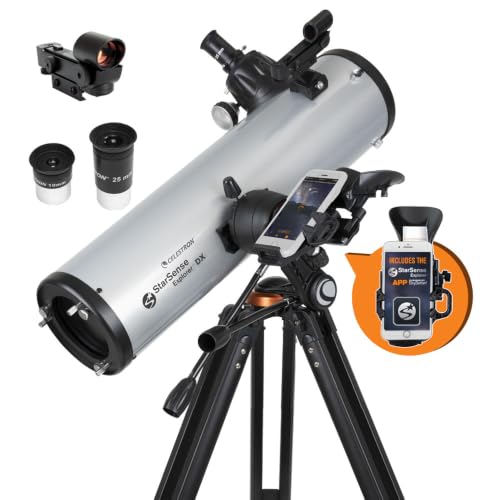
The DX 130AZ uses the same StarSense idea as the model in first place on a smaller scale. According to Celestron, it has a 130 mm (5.11 inch) parabolic Newtonian mirror at f/5 and 650 mm focal length, a manual alt-azimuth mount, 25 mm and 10 mm eyepieces (26x and 65x), a StarPointer red-dot finderscope and a phone dock. The total kit is 18 lbs, with an 8.8 lb tube and a 9.2 lb tripod.
For a beginner who wants to be guided without hauling a 43 lb scope, this is a sensible middle path. It offers two eyepieces in the box, which gives you a wide view and a higher-power view from day one. Celestron recommends keeping your phone charged, because the app depends on it.
It ranks eighth because it gives up three inches of aperture to the leader. It still shows the Moon, planets, clusters and the brightest nebulae well. See the DX 130AZ profile.
9. Sky-Watcher Heritage 150 Tabletop Dobsonian — The Grab-and-Go Dobsonian
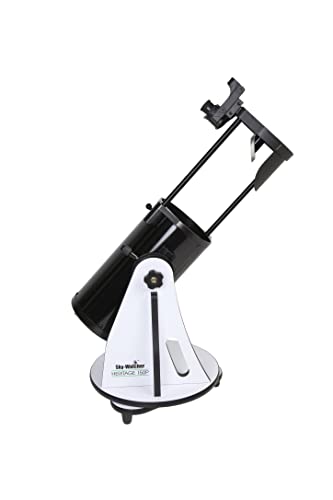
The Heritage 150 is a 150 mm (about 6-inch) tabletop Dobsonian, f/5, 750 mm focal length. According to Sky-Watcher USA, it has a borosilicate parabolic mirror with RAQ coating, a collapsible tube that retains collimation, a manual azimuth mount with Teflon bearings and a 1.25-inch helical focuser. Sky-Watcher describes it as a grab-and-go travel telescope.
That collapsible tube is its trick: it shrinks for the car and extends for use. A 6-inch mirror gathers a lot of light for its size, so it makes a good camping or balcony scope as long as you have a stable table, bench or low wall.
Sky-Watcher’s page does not state weight, eyepieces or warranty, so confirm those with the seller. It ranks ninth because the tabletop base limits where you can use it, and because the missing details add uncertainty. See the Heritage 150 profile.
10. Celestron Inspire 100AZ — The Simple Starter Refractor
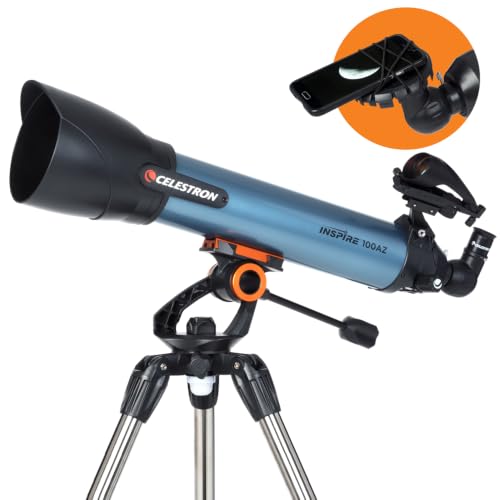
The Inspire 100AZ is a short 100 mm (3.94 inch) refractor, f/6.5, 660 mm focal length. According to Celestron, it has fully coated optics, a manual alt-azimuth mount on a steel tripod, a 90 degree erect-image diagonal, 20 mm and 10 mm Kellner eyepieces (33x and 66x), a StarPointer Pro finderscope and a red LED flashlight. It also supports the SkyPortal app. The total kit is 12.4 lbs.
The erect-image diagonal means it also works for daytime viewing, which suits a household that wants one scope for birds and the Moon. A refractor needs no collimation and is ready quickly.
It ranks tenth because it has the smallest aperture in the group, so faint galaxies and nebulae look dim. As a first scope for the Moon, planets and bright clusters, it is a sensible entry point. See the Inspire 100AZ profile.
Which One Should You Buy?
Most adults who want one scope for years: the Celestron StarSense Explorer 8” Dobsonian. Big aperture, phone-guided finding and no power requirements.
You want automatic finding and tracking in an 8-inch: the Celestron NexStar 8SE. It needs power and sits higher in the price range, but it does the searching for you.
You want photos with the least effort: the Seestar S50 Pro. It is portable, automated and built around the app.
You like learning the sky by hand: the Sky-Watcher Classic 200P Dobsonian. Same aperture as number one, with a traditional approach and no electronics.
You want GoTo in a smaller, lighter kit: the Celestron NexStar 6SE. Less aperture than the 8SE and an easier carry.
You live in a city and want a screen-based experience: the Unistellar Odyssey. Live stacking helps in light-polluted skies, and a group can watch together.
You travel and want to try astrophotography: the DwarfLab DWARF 3. It is the lightest option, but buy a tripod separately.
You want phone guidance in a lighter scope: the Celestron StarSense Explorer DX 130AZ. Smaller than the leader, with two eyepieces included.
You camp or have limited space: the Sky-Watcher Heritage 150 Tabletop Dobsonian. Collapsible and portable, but it needs a stable surface.
You want a simple, budget-friendly start for the Moon and planets: the Celestron Inspire 100AZ. Small aperture and light weight.
In terms of budget, the Heritage 150, the Inspire 100AZ and the DX 130AZ sit at the entry end, the 8-inch Dobsonians and the NexStar 6SE sit in the middle, and the NexStar 8SE and the smart telescopes sit at the higher end. Check the current price on Amazon before you decide.
Conclusion
For most adults, the Celestron StarSense Explorer 8” Dobsonian is the best starting point: it has the aperture to stay interesting and the app to keep it friendly. The NexStar 8SE is the upgrade for anyone who wants tracking, the Seestar S50 Pro is the answer if photos matter more than eyepieces, and the Sky-Watcher Classic 200P is the purist’s alternative. The smaller scopes further down the list are good answers to specific limits: space, weight, travel or a tight budget.
One reminder applies to every telescope here: never point any of them at the Sun without a certified solar filter (ISO 12312-2) over the full aperture.
We rank the Celestron StarSense Explorer 8" Dobsonian first. According to Celestron it combines a 203 mm mirror with an app that uses your phone camera to guide you to targets. It is manual and heavy at 43.4 lbs, so confirm you have room to store it.
Are smart telescopes better than traditional ones?
They solve different problems. Smart telescopes such as the Seestar S50 Pro, Unistellar Odyssey and DWARF 3 find, track and stack images for you and show the result on a phone. Traditional scopes have much larger apertures and an eyepiece. Pick a smart telescope for photos, and a Dobsonian or SCT for looking.
Do I need a GoTo mount?
No. GoTo mounts like the NexStar 8SE and 6SE find objects automatically and track them, but they need power and cost more. A manual Dobsonian with a phone app or a red-dot finder works well if you are happy to push the tube.
Which telescope is easiest to carry?
The DWARF 3 weighs about 3 lbs (1.35 kg) according to DwarfLab, and the Seestar S50 Pro main unit is about 6.2 lbs (2.8 kg) according to Seestar. Among traditional scopes, the Celestron Inspire 100AZ lists 12.4 lbs and the Heritage 150 is a collapsible tabletop design, though Sky-Watcher does not state its weight.
Can I see anything from a city?
Yes. The Moon and planets look fine under streetlights with any scope here, and bright clusters and double stars are within reach. Fainter nebulae and galaxies need darker skies, although smart telescopes with built-in filters can pull out more from light-polluted areas.
Can I look at the Sun with these telescopes?
Never point any telescope at the Sun without a certified solar filter (ISO 12312-2) covering the full aperture. The Seestar S50 Pro and DWARF 3 list solar filters in the package according to their makers. Follow each maker's instructions, and do not improvise.