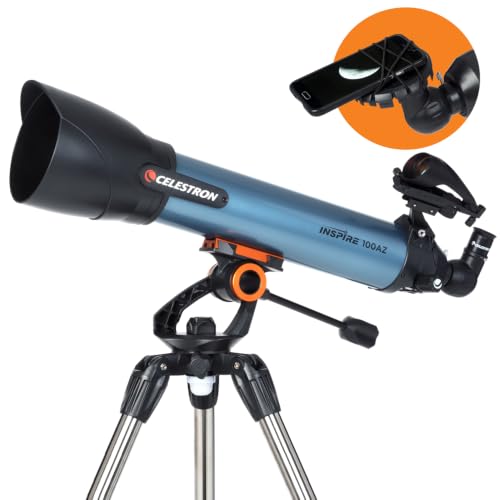
The Celestron Inspire 100AZ is a short refractor with a 100 mm (3.94 inch) lens, a manual alt-azimuth mount and a light kit that sets up without tools. It is aimed at buyers who want something quick to put out and quick to put away, and Celestron pitches it for both night and daytime use.
We compared the specifications on Celestron’s own product page and organized them below. We have not handled the telescope ourselves, so we do not describe observations we have not made.
Who the Inspire 100AZ Is For
The Inspire 100AZ suits:
First-time buyers who value ease. Celestron says you can assemble the telescope and accessories in just a few minutes, even on your first time out, with no extra tray to attach because it is built into the tripod. That removes most of the friction that keeps a telescope in the closet.
People who want one instrument for day and night. The 90 degree erect-image diagonal produces a right-side-up view, which Celestron says makes the tube suitable as a daytime spotting scope. A telescope with a standard diagonal, in contrast, shows a mirror-reversed or inverted view that is awkward for birds and landscapes.
Casual phone photographers. The integrated smartphone adapter lets you hold a phone to the eyepiece for pictures of the Moon, planets and terrestrial subjects.
Celestron does not state a minimum age for this telescope, and says that an adult familiar with the correct operating procedures should be with the optic at all times, especially when children are present.
It is a weaker match for anyone who wants to see faint galaxies and nebulae at their best, which depends on aperture, or who wants motorized tracking.
Key Specs
| Spec | Value | Source |
|---|
| Optical design | Refractor, fully coated optics | Celestron |
| Aperture | 100 mm (3.94 inches) | Celestron |
| Focal length / ratio | 660 mm (25.98 inches), f/6.5 | Celestron |
| Eyepieces | 20 mm (33x) and 10 mm (66x) Kellner | Celestron |
| Diagonal | 90 degree erect-image, 1.25 inch | Celestron |
| Finderscope | StarPointer Pro red dot | Celestron |
| Limiting stellar magnitude | 12.5 | Celestron |
| Light gathering power | 212x the unaided eye | Celestron |
| Resolution (Dawes) | 1.14 arcseconds | Celestron |
| Highest / lowest useful magnification | 241x / 15x | Celestron |
| Optical tube length / weight | 17.2 inches (436 mm) / 4.9 lbs (2.2 kg) | Celestron |
| Mount | Manual alt-azimuth, panning handle with clutch | Celestron |
| Tripod | Steel legs, adjustable 32 to 51 inches, built-in accessory tray | Celestron |
| Tripod and mount weight | 8 lbs (3.64 kg) | Celestron |
| Total kit weight | 12.4 lbs (5.62 kg) | Celestron |
| Software | Starry Night Basic Edition, SkyPortal app | Celestron |
| Warranty / returns | 2 years / 30 days | Celestron |
Optics and What You Can Realistically See
The Inspire 100AZ is a refractor: a lens at the front focuses light to the eyepiece at the back. Refractors have a closed tube, need little maintenance and usually have no collimation routine, which makes them forgiving for beginners. This one is a short, fast design at f/6.5, and Celestron says its short tube offers a wider field of view suited to the planets, the Moon, star clusters and brighter deep-sky objects, with the Orion Nebula and Andromeda Galaxy as named examples.
Aperture sets the limit. A 100 mm lens gathers about 212 times as much light as the unaided eye, according to Celestron, which is meaningfully less than the 130 mm and larger reflectors elsewhere on this site. As general astronomy knowledge, that means the Moon will show crisp craters, Jupiter will show its cloud belts and moons, Saturn’s rings will be visible, and double stars and open clusters will look good. Galaxies and nebulae will appear as faint patches, and they look best under dark skies away from town.
A known trade-off of a short, achromatic-type refractor is color fringing around bright objects. Celestron’s page does not discuss it and we have no measurements to offer, so we simply note that it is common in fast refractors and may show on the Moon’s edge or on bright stars.
The two Kellner eyepieces give 33x and 66x. That is a sensible pair for a first telescope, with the 20 mm for finding things and the 10 mm for closer looks. Celestron lists a highest useful magnification of 241x, so there is room to add an eyepiece for more power. The erect-image diagonal is convenient for daytime use, though many astronomers prefer a standard diagonal for night viewing; Celestron says the erect-image diagonal can be used for celestial objects as well.
Mount and Finding Objects
The mount is a manual alt-azimuth with a panning handle and a clutch, according to Celestron. You loosen the clutch and pan the tube up, down, left and right to follow an object in the eyepiece. A StarPointer Pro red-dot finderscope helps you aim, and Celestron says it speeds up centering an object. The SkyPortal app and Starry Night Basic Edition software are included for planning and learning the sky.
There is no motor and no app-guided pointing like the StarSense models, so finding fainter objects means star-hopping with a chart or an app on your phone. That is a skill many people enjoy, and it takes some patience at first.
Setup, Weight and Portability
Portability is the Inspire 100AZ’s selling point. The whole kit weighs 12.4 lbs (5.62 kg), the tube is 17.2 inches long and weighs 4.9 lbs (2.2 kg), and the tripod and mount together weigh 8 lbs (3.64 kg), according to Celestron. The tripod height adjusts from 32 to 51 inches, so you can set it on a picnic table or stand at full height. Celestron describes the kit as suited to impromptu sessions and to transport.
An integrated red LED flashlight fits in the mount to light the tray and can be removed for use as a flashlight, which helps preserve your night vision.
What’s in the Box and What You’ll Want to Add
According to Celestron, the kit includes the optical tube, the mount with tripod and folding accessory tray, a red LED flashlight, the 90 degree erect-image diagonal, the 20 mm and 10 mm Kellner eyepieces, the StarPointer Pro finderscope and a free download of SkyPortal. Celestron’s description also lists an integrated smartphone adapter.
Accessories worth considering:
- A better or higher-power eyepiece, for sharper planetary views.
- A Moon filter, which Celestron sells and which reduces glare at low power.
- A carrying bag, since Celestron sells telescope and tripod bags separately.
- A star chart or planetarium app, since the mount has no object finding of its own.
Celestron’s solar warning is plain: never look directly at the Sun with the naked eye or with an optic unless you have the proper solar filter, because permanent and irreversible eye damage may result. Never use the optic to project an image of the Sun onto any surface, and never leave it unsupervised.
Alternatives on This Site
For a bigger aperture with app guidance, the Celestron StarSense Explorer DX 130AZ is a 5-inch reflector with a phone dock and on-screen arrows. It is heavier, at 18 lbs for the kit, according to Celestron.
For a simple, larger-aperture option without a tripod, the Sky-Watcher Heritage 150 is a 6-inch tabletop Dobsonian, with the catch that it needs a stable surface and Sky-Watcher’s page does not list its weight or eyepieces.
Who Should Skip It
Skip the Inspire 100AZ if deep-sky viewing is your main goal, since aperture matters most there, or if you want a computerized mount. If you already know you will want to photograph through the telescope beyond phone snapshots, look at a different category.
Verdict
The Celestron Inspire 100AZ is an easy, light and flexible first telescope. A 100 mm refractor with no collimation chore, a no-tool setup, an erect-image diagonal for daytime use and a built-in phone adapter covers the first year of casual observing well. It is not the strongest choice for faint objects, and its basic eyepieces and manual mount will eventually feel limiting for keen observers. For people who want to start quickly and keep things simple, it is a solid entry point. See how it ranks against the other nine models in our best telescopes of 2026 comparison.
See price on Amazon
Sources