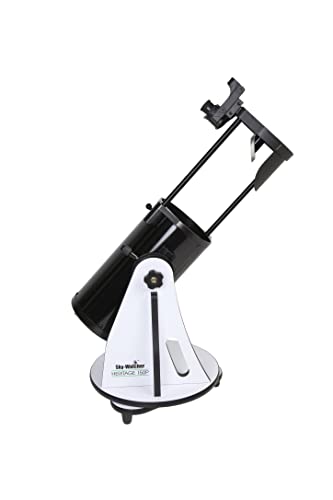
The Sky-Watcher Heritage 150 is a 6-inch tabletop Dobsonian with a tube that collapses for storage and travel. It belongs to the family of simple, manual telescopes that put the budget into the mirror and skip the electronics. There is no app, no motor and no power requirement: you point it by hand and look through the eyepiece.
We compared the specifications from Sky-Watcher USA’s own product page and organized them below. That page is brief. It gives the optics and mount design but does not list weight, eyepieces or warranty, and we do not fill those gaps with guesses. We have not handled the telescope ourselves, and we do not describe observations we have not made.
Who the Heritage 150 Is For
The Heritage 150 suits:
People who want real aperture in a small package. A 150 mm (5.9-inch) parabolic mirror gathers far more light than a typical small refractor, and the collapsible tube makes storage easier than with a fixed-tube scope of the same aperture.
Campers and travelers. Sky-Watcher describes the telescope as a grab-and-go travel scope and a camping companion. It is the sort of instrument you can put in a car trunk for a trip to a darker site.
Beginners who prefer a manual telescope. A Dobsonian-style base is about as simple as a mount gets: move the tube up and down and swing it side to side. There is nothing to align, no batteries to run down and nothing to learn beyond finding objects in the sky.
It is a weaker fit for anyone who wants motorized tracking, a phone app that finds objects, or the option to take long-exposure photographs. It also needs a stable surface to sit on, so if you have no suitable table, bench or wall, you need to plan for one.
Key Specs
| Spec | Value | Source |
|---|
| Optical design | Newtonian reflector with parabolic primary mirror | Sky-Watcher USA |
| Aperture | 150 mm (about 6 inches) | Sky-Watcher USA |
| Focal length / ratio | 750 mm, f/5 | Sky-Watcher USA |
| Primary mirror | Borosilicate glass, Radiant Aluminum Quartz (RAQ) coating | Sky-Watcher USA |
| Tube | Collapsible, retains collimation | Sky-Watcher USA |
| Focuser | 1.25-inch helical | Sky-Watcher USA |
| Mount | Manual azimuth base, Teflon bearings, altitude locking knob | Sky-Watcher USA |
| Base design | Tabletop, rubber feet | Sky-Watcher USA |
| Light gathering | About 1.3 times the area of a 130 mm mirror (area math from the apertures) | Our calculation |
| Optics shared with | Classic 150P Dobsonian | Sky-Watcher USA |
| Weight, eyepieces, warranty | Not stated on the product page | Confirm with the seller |
Optics and What You Can Realistically See
The Heritage 150 uses a parabolic mirror, which focuses light to a point and avoids the spherical aberration that affects cheaper spherical mirrors. The primary mirror is made of borosilicate glass with Sky-Watcher’s RAQ coating, according to Sky-Watcher USA. At f/5 with a 750 mm focal length, the telescope gives a fairly wide field of view with a low-power eyepiece.
The magnification you get depends on the eyepiece, and Sky-Watcher’s page does not list which eyepieces come with the telescope. As a general rule, magnification equals the telescope’s focal length divided by the eyepiece’s focal length. With a 750 mm focal length, a 25 mm eyepiece would give 30x and a 10 mm eyepiece would give 75x. Those figures are illustrations of the formula, not a statement of what is in the box.
A 6-inch aperture is a capable size for visual astronomy. As general astronomy knowledge, you can expect the Moon in sharp detail, the rings of Saturn, the cloud belts of Jupiter and its four large moons, and many double stars and bright star clusters. The brighter nebulae and galaxies show as faint gray patches under a dark sky; they are much harder from a bright town. Larger Dobsonians will show more, but at the cost of size and weight.
One feature to appreciate is the collapsible tube. Sky-Watcher says it retains collimation, which is the alignment of the mirrors. Newtonian reflectors can drift out of alignment, and many owners find collimation the most intimidating part of the hobby. A design that keeps the alignment through collapse and extension reduces that chore, though it is not a promise that you will never need to adjust. The page does not describe a collimation procedure, so check the manual that comes with the telescope.
Mount and Finding Objects
The mount is a manual azimuth base with Teflon bearings for smooth slewing and an altitude locking knob for steadier viewing, according to Sky-Watcher USA. The base has rubber feet to reduce vibration, and the telescope is designed to sit on a table or other raised surface.
Finding objects is entirely by hand. The product page does not list a finder, so confirm what comes with the telescope. If there is no finder in the box, adding a red-dot finder is one of the most useful first purchases. A star chart or a planetarium app on your phone will do the rest. Because the mount is not motorized, objects drift out of the eyepiece as the Earth turns, and you nudge the tube to follow them. At low power that is easy; at high power you will be adjusting more often.
Setup, Weight and Portability
This is where the Heritage 150 is designed to shine. The collapsible tube shortens it for storage and transport, and the tabletop base is small. Sky-Watcher calls it a grab-and-go travel telescope.
What we cannot tell you is how much it weighs, because the maker’s page does not say. If you plan to carry it a long way, fly with it, or have trouble lifting heavy loads, ask the seller for the shipping weight, or look it up in the manual before you order. The same goes for the packed dimensions.
The need for a table is the practical trade-off. Choose a surface that does not wobble, and be careful with the setup: a telescope on a table is an easy thing to knock off.
What’s in the Box and What You’ll Want to Add
The Sky-Watcher USA product page does not list what ships with the telescope. That means eyepieces, finder and any accessories need to be confirmed with the seller before you buy. We would not assume anything is or is not included.
Worth adding:
- A red-dot finder or equivalent, if the box does not include a finder.
- An extra eyepiece, for a second magnification.
- A sturdy table or stand at a comfortable height.
- A red flashlight, to protect your night vision when reading charts.
On solar viewing: never look at the Sun through any telescope without a certified solar filter made for the instrument. Permanent eye damage can happen in an instant. If you want to observe the Sun, buy a full-aperture solar filter that meets ISO 12312-2 requirements for viewers or is made for your telescope, and follow its instructions exactly.
Alternatives on This Site
If you want a bit more help finding objects while keeping a manual mount, the Celestron StarSense Explorer DX 130AZ adds a phone app that guides you with on-screen arrows, on a full-height tripod instead of a table.
If you want a small, light kit on a tripod with a smaller aperture, the Celestron Inspire 100AZ is a 100 mm refractor whose weight, eyepieces and accessories Celestron spells out in full. Within Sky-Watcher’s own range, the Classic 200P Dobsonian on this site is the larger 8-inch step up, on a floor-standing base instead of a tabletop one.
Who Should Skip It
Skip the Heritage 150 if you do not have a stable surface to put it on, if you want automatic tracking or app-guided finding, or if you want photography beyond a phone held to the eyepiece. If you need exact weight and a confirmed accessory list before you buy, ask for them first, since the maker’s page does not provide them.
Verdict
The Sky-Watcher Heritage 150 gives you a 6-inch parabolic mirror, a collapsible tube that retains collimation and a simple manual base, in a package meant for grab-and-go use. The gaps are on the information side: the maker’s page does not give weight, eyepieces or warranty, so verify those with the seller. For someone who has a sturdy table and wants an uncomplicated telescope for the Moon, planets and brighter deep-sky objects, it is a strong candidate. If you want electronics, tracking or imaging, look elsewhere. See how it ranks against the other nine models in our best telescopes of 2026 comparison.
See price on Amazon
Sources