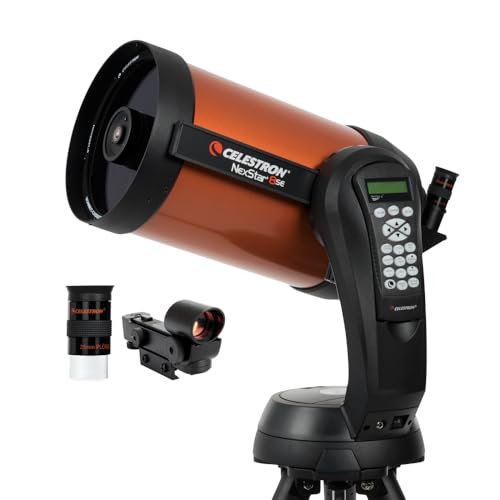
The Celestron NexStar 8SE is a computerized telescope that combines 8 inches of aperture with a motorized single-fork-arm mount. You align it once, pick an object on the hand control or in the app, and the scope slews there and then tracks it as the sky turns. Celestron’s orange-tube SE series is aimed at people who want GoTo without a permanent setup, and the 8SE is the larger of the two SE models we cover.
We did not handle this telescope. This profile gathers Celestron’s published specifications, explains how a Schmidt-Cassegrain behaves in general, and notes where the design asks for trade-offs. Celestron’s own page describes it as the perfect choice for a first serious telescope.
Who It’s For
The 8SE fits three kinds of buyers. The first is the person who wants a lifelong telescope and would rather buy one capable scope than upgrade three times. The second is the observer who loves the idea of dialing up a target and having the telescope find it, especially from a backyard with limited sky visibility or from a light-polluted suburb where star-hopping is frustrating. The third is a planetary observer who wants a long focal length for high-magnification views of the Moon and planets, with the possibility of adding a camera later.
It fits less well if you need to carry the telescope far, if you dislike batteries and cables, or if your main goal is deep-sky photography. If you prefer a simple, silent approach, our profile of the Celestron StarSense Explorer 8-inch Dobsonian has the same aperture in a manual design.
Key Specs According to Celestron
| Spec | Value |
|---|
| Optical design | Schmidt-Cassegrain |
| Aperture | 203.2 mm (8 inches) |
| Focal length | 2032 mm (80 inches) |
| Focal ratio | f/10 |
| Mount | Computerized altitude-azimuth, single fork arm |
| Alignment | SkyAlign, 2-star alignment |
| Database | 40,000+ objects (NexStar+ hand control) |
| App | SkyPortal software |
| Eyepiece included | 25 mm (81x) |
| Finder | StarPointer red-dot finderscope |
| Diagonal | 1.25-inch star diagonal |
| Weight | 32 lbs total (tube 12 lbs, tripod 9 lbs, mount head 11 lbs) |
| Power | 8 AA batteries (not included) or 12 VDC, 750 mA |
| Warranty | 2 years, with 30-day returns |
Every figure above comes from Celestron’s NexStar 8SE product page.
Optics and What You Can Realistically See
A Schmidt-Cassegrain telescope folds the light path using a front corrector plate, a primary mirror and a secondary mirror. The result is a 2032 mm focal length packed into a short tube, which is the main reason the 8SE is so compact for its aperture.
The 8-inch aperture gathers a great deal of light. Celestron says it reveals Cassini’s Division in Saturn’s rings, the cloud bands on Jupiter and the Great Red Spot, craters and geographic features on the Moon, hundreds of pinpoint stars in the Hercules Globular Cluster, and the spiral arms of the Whirlpool Galaxy. Based on general knowledge of the 8-inch class, here is how to calibrate those claims:
- Moon and planets: this is the 8SE’s strongest suit. The long focal length delivers high magnification easily, and the optics are well suited to Jupiter, Saturn and Mars when it is close to Earth. Steady air matters more than any specification.
- Bright deep-sky objects: globular clusters, the Orion Nebula, the Ring Nebula and bright galaxies like Andromeda are well within reach. Under a dark sky, the Whirlpool shows a hint of structure, as Celestron describes, but it appears as a faint gray glow rather than a photograph.
- Wide-field targets: with an f/10 focal ratio and a standard eyepiece, fields of view are narrow. Large objects such as the full Andromeda galaxy or the Pleiades do not fit well in the field. A wide-angle eyepiece with a focal reducer, or a smaller, shorter-focus scope, suits those targets better.
The included 25 mm eyepiece gives 81x, which is a useful general-purpose power. Schmidt-Cassegrains also need time to match the outside temperature, so give the scope a while outdoors before critical viewing. Images through the star diagonal are right-side up but mirror-reversed, which matters when comparing with a printed chart.
Mount and Finding Objects
The single-fork-arm mount is Celestron’s signature design. According to Celestron, it is patented, breaks down into several lightweight pieces and delivers the pointing and tracking accuracy needed to follow targets with push-button ease.
The NexStar+ hand control locates over 40,000 celestial objects and includes a Sky Tour mode that suggests the best objects visible tonight. Alignment uses SkyAlign: Celestron describes the process as centering three bright objects in the eyepiece and pressing ALIGN, with no need to know their names. For even simpler alignment, the maker sells a StarSense AutoAlign accessory that aligns the telescope on its own, and a SkySync accessory to add GPS data. Both are sold separately.
Because the mount is alt-azimuth, it tracks by moving in two axes at once. For visual observing, that is fine. For photography, it creates field rotation during long exposures, which is why serious deep-sky imagers use equatorial mounts. Celestron points to short exposures of planets with NexImage cameras and Fastar-compatible wide-field imaging as the intended imaging routes.
Setup, Weight and Portability
At 32 lbs total, split into a 12 lb tube, a 9 lb tripod and an 11 lb mount head, the 8SE is something most adults can carry in two or three pieces. Celestron notes that it transports easily, even in small vehicles, and takes only a few minutes to put together. It is also much less bulky than an 8-inch Dobsonian.
Power is the practical annoyance. Celestron specifies 8 AA batteries or a 12 VDC, 750 mA supply. If you plan to use it regularly, a rechargeable 12V power pack with the proper connector is the more economical route over the long term than a steady stream of AA batteries. Cold nights drain batteries faster.
What’s in the Box and What You’ll Want to Add
According to Celestron, you get the optical tube, the computerized mount and tripod, the NexStar+ hand control, a 25 mm eyepiece (81x), a StarPointer red-dot finderscope, a 1.25-inch star diagonal and an accessory tray. Batteries are not included.
Common additions:
- A 12V power supply or rechargeable power tank, rather than AA cells.
- More eyepieces. One 25 mm eyepiece is a start. A lower-power wide-field eyepiece and a higher-power eyepiece make a big difference.
- A focal reducer if you want wider fields of view.
- A dew shield, because the open front of an SCT corrector plate is prone to dew.
- StarSense AutoAlign or SkySync, if you want easier alignment.
- A certified solar filter, only if you plan to observe the Sun. Never point any telescope at the Sun without a proper full-aperture solar filter designed for it (ISO 12312-2 compliant). None is included.
Pros and Cons
Pros
- Large 8-inch aperture in a compact tube.
- GoTo and tracking make it easy to share views with family and friends.
- A mature accessory ecosystem and the option to add imaging gear.
- A design that can serve as a lifelong telescope.
Cons
- Added cost of power, eyepieces and accessories.
- Narrow default fields of view.
- Not meant for long-exposure deep-sky imaging.
- Setup is slower than a manual scope.
Alternatives on This Site
Verdict
The NexStar 8SE remains one of the most sensible ways to own a big-aperture telescope that is easy to use. It does not try to be the best at everything: it is not a wide-field scope, not a photography platform and not the lightest option. What it does offer is a combination of aperture, automation and portability that is hard to match. If you value finding objects quickly and want a telescope you will not outgrow, it is a strong candidate. If you prefer simplicity and quiet, a Dobsonian is the alternative. See how it ranks against the other nine models in our best telescopes of 2026 comparison.
Sources
See the Celestron NexStar 8SE on Amazon