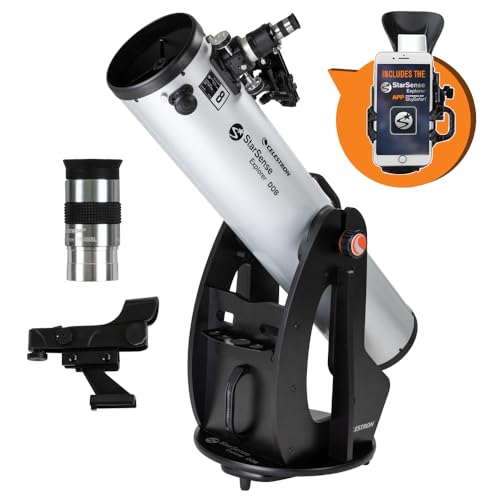
The Celestron StarSense Explorer 8-inch Dobsonian is a large manual reflector with a twist: instead of a computerized mount, it uses your smartphone to work out where the tube is pointing and then walks you to the target with on-screen arrows. If you have read about telescopes for a while, you know the golden rule of visual astronomy: aperture wins. This model puts a 203 mm mirror in a design that is cheaper to build than a motorized scope of the same size, then adds an app to remove the hardest part of the hobby for beginners, which is finding things.
We did not handle this telescope. This profile organizes the specifications from Celestron’s product page, adds general astronomy knowledge about what an 8-inch aperture can and cannot show, and points out where the design asks for trade-offs. For a neighboring scope with the same aperture and a simpler, app-free approach, see our profile of the Sky-Watcher Classic 200P.
Who It’s For
This scope fits a beginner who is serious about the hobby and wants a telescope that will not feel limiting in a year. An 8-inch mirror is the size many amateur astronomers settle on for good, and Celestron says outright that the large aperture is meant to keep you from outgrowing the telescope. It also fits adults who have tried a small scope, found the views dim, and want a jump in capability without learning to read star charts first.
It is less suited to anyone who needs to carry a telescope up several flights of stairs, store it in a small closet, or use it on a balcony without much clearance. It is also the wrong tool for astrophotography and is not a quick grab-and-go option. If you want grab-and-go, look at a smaller scope such as the Celestron StarSense Explorer DX 130AZ or the Sky-Watcher Heritage 150 tabletop Dobsonian, both covered elsewhere on this site.
Key Specs According to Celestron
| Spec | Value |
|---|
| Optical design | Newtonian reflector |
| Aperture | 203 mm (8 inches) |
| Focal length | 1200 mm (47.24 inches) |
| Focal ratio | f/5.9 |
| Mount | Manual altazimuth Dobsonian base |
| Focuser | 2-inch Crayford with 2-inch extension tube and 2-inch-to-1.25-inch adapter |
| Eyepiece included | 25 mm (48x) |
| Finder | StarPointer red-dot finderscope |
| Light gathering | 841 times the human eye, limiting magnitude 14.2 |
| Weight | 43.4 lbs total (optical tube 20.6 lbs, base 22.8 lbs) |
| Warranty | 2 years, with 30-day returns |
All values above are according to Celestron’s product page for this model. The limiting magnitude and light-gathering figures are theoretical numbers for the aperture. Real-world results depend on your sky, the telescope’s condition and your eyes.
Optics and What You Can Realistically See
Aperture controls two things: how much light the telescope gathers and how much fine detail it can resolve. At 8 inches, you gather roughly four times as much light as a 4-inch scope and nearly twice as much as a 6-inch. Compared with Celestron’s own 130 mm StarSense Explorer DX, the 203 mm mirror has roughly 2.4 times the light-gathering area (simple area math from the two apertures), which makes the step up in faint-object performance obvious on paper.
What that means at the eyepiece, based on general knowledge of the 8-inch class:
- The Moon: craters, mountain ranges, rilles and the terminator shadows are detailed and sharp. At this aperture the Moon is bright enough that many observers use a moon filter or a higher-power eyepiece to cut glare.
- Planets: Jupiter shows its cloud bands and four Galilean moons. Saturn’s rings are clear, and in steady air the gap in the rings can be glimpsed. Celestron says you can expect the Great Red Spot and the cloud bands on Jupiter, and the rings of Saturn. Planets are small, so they reward a higher-power eyepiece than the 25 mm that ships with the scope.
- Star clusters and double stars: open clusters such as the Pleiades fill the field nicely, and a globular cluster like M13 starts to resolve into individual stars at the edges.
- Nebulae and galaxies: the Orion Nebula is a highlight, with structure and a faint greenish-gray glow. Andromeda is easy, and under dark skies you can pick up spiral hints in brighter galaxies. Remember that faint deep-sky objects look gray and subtle to the eye, not like colorful photographs, because human vision is not sensitive to color at low light levels.
A few practical notes. Newtonian reflectors need time to cool to outdoor temperature before the views are at their best, so set the scope outside for a while before you observe. The mirrors can also drift out of alignment over time, which is why collimation, a simple adjustment procedure, is a normal part of owning one. Occasional collimation is typical of the whole Newtonian category, not a flaw specific to this model.
Under the fast f/5.9 optics, low-power wide views are easy, but a good set of extra eyepieces matters. A common rule of thumb limits useful magnification to about 50x per inch of aperture, roughly 400x here, but typical atmospheric seeing usually caps it much lower, often around 200x to 300x on good nights.
Mount and Finding Objects
The base is the difference between this model and a bare-bones Dobsonian. Celestron describes large-diameter altitude bearings with variable tension, Teflon azimuth bearings, and side-panel braces for stability. A panning knob on the tube gives you a handle for moving it. Because the mount is manual, objects drift out of the field of view as Earth rotates, and you re-center them by hand. At low power this is a minor chore, and at high power on a planet you will be nudging the tube frequently.
Finding objects is where StarSense Explorer earns its name. You put your phone into the dock on the tube, open the app, and complete a quick alignment of the phone to the optics. According to Celestron, the app then uses the phone camera to recognize star patterns and determine where the telescope points. It lists targets visible tonight, shows arrows on-screen as you push the tube, and a bullseye turns green when the object is in the eyepiece. Celestron describes this as more accurate than apps that rely only on the phone’s motion sensors. The app also includes audio descriptions and information on thousands of objects.
Two cautions. First, the app is phone-dependent, so battery matters on cold nights. Celestron suggests its PowerTank Glow 5000 as a charger and red flashlight, sold separately. Second, you still need a reasonably dark sky and a clear view of the horizon and zenith for the camera to work well.
Setup, Weight and Portability
Celestron lists 43.4 lbs for the complete kit, with a 20.6 lb tube and a 22.8 lb base. That is manageable for most adults, but it is not something you casually carry from a third-floor apartment. The two units separate, and the handles are placed near their balance points. In practice, plan on keeping it in a garage, a shed or a ground-floor closet, and wheeling or carrying the two pieces to the observing spot.
Setup itself is simple: set the base on level ground, lower the tube in, remove dust covers, dock your phone, and align. There is no tripod to level and no power cable to run. Dust covers for the front of the tube and the focuser are included, according to Celestron.
For comparison, the Celestron NexStar 8SE has the same 8-inch aperture in a folded Schmidt-Cassegrain tube that weighs 12 lbs, but it needs power and a tripod. The Dobsonian trades some portability for a much simpler, silent, battery-free mount.
What’s in the Box and What You’ll Want to Add
According to Celestron, the kit includes the optical tube, the Dobsonian base, a 25 mm eyepiece giving 48x, a StarPointer red-dot finderscope, the StarSense Explorer phone dock, an eyepiece rack, the 2-inch Crayford focuser with its extension tube and adapter, and dust covers.
Items worth adding over time:
- A second eyepiece or two. A shorter focal length, such as a 10 mm or a 12 mm, gives you higher power for planets and the Moon. A good wide-field 2-inch eyepiece takes advantage of the large focuser.
- A power bank or the PowerTank Glow 5000 to keep your phone alive through a long session.
- A collimation tool, such as a Cheshire or a laser collimator, so you can keep the mirrors aligned.
- A red flashlight to protect your night vision.
- A certified solar filter, only if you plan to view the Sun. Never point the telescope at the Sun without a proper full-aperture solar filter designed for it (ISO 12312-2 compliant). It is not included.
Pros and Cons
Pros
- The aperture class most hobbyists end up wanting anyway.
- Phone-guided finding takes the worst learning curve out of the hobby.
- A quiet, battery-free mount that is ready in minutes.
- The 2-inch focuser leaves room to grow.
Cons
- Big and heavy for storage and transport.
- No tracking, so no hands-free viewing or astrophotography.
- Needs occasional collimation and a cooldown period.
- Needs extra eyepieces for higher-power planetary work.
Alternatives on This Site
- Sky-Watcher Classic 200P: the same 8-inch aperture on a traditional Dobsonian mount, with no app and a lean accessory package. It suits observers who like to learn the sky by star-hopping.
- Celestron NexStar 8SE: 8 inches again, but with a motorized GoTo mount, a longer focal length and a more compact tube. It is a better route for tracking and for planetary imaging experiments, at the cost of power requirements and a higher focal ratio.
- Celestron StarSense Explorer DX 130AZ: a smaller, lighter 5-inch scope with the same phone-guidance idea, for those who cannot handle the bulk of an 8-inch.
- Sky-Watcher Heritage 150: a tabletop Dobsonian for travel and camping.
Verdict
If your priority is the best views for the least complexity, the StarSense Explorer 8-inch Dobsonian is one of the most sensible designs in the beginner-to-intermediate range. The app solves the finding problem, and the optics leave you room to grow for years. It asks only two things in return: floor space, and a willingness to push the tube by hand. If you cannot meet both conditions, one of the smaller or motorized options in our lineup will serve you better. See how it ranks against the other nine models in our best telescopes of 2026 comparison.
Sources
See the Celestron StarSense Explorer 8-inch Dobsonian on Amazon