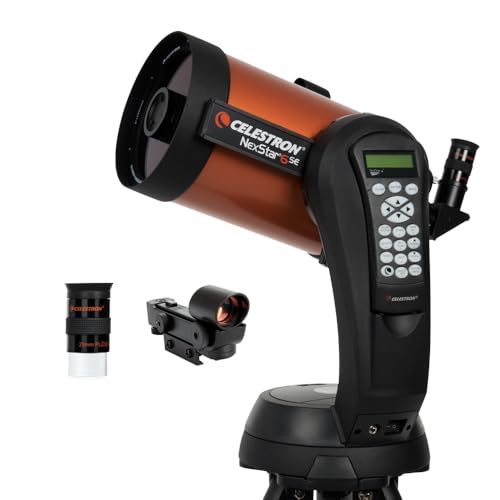
The Celestron NexStar 6SE is the smaller of Celestron’s two orange-tube SE telescopes: a 6-inch Schmidt-Cassegrain optical tube on a computerized single-fork-arm mount. It is meant for observers who want a telescope that can find and track objects on its own, without taking on the weight of an 8-inch scope or the footprint of a Dobsonian.
We did not handle this telescope. This profile organizes Celestron’s published specifications, adds general knowledge about what a 150 mm aperture can show, and points out where the design asks you to compromise.
Who It’s For
The 6SE suits a few groups. If you live in a suburb or small city and want to see the Moon and planets in detail, a 6-inch aperture is enough to show cloud bands on Jupiter and the rings of Saturn. If you travel to dark-sky sites and want a telescope that fits into the back seat of a small car, the 28 lb total kit is easier to manage than larger scopes. And if you like the idea of selecting an object from a list and letting the telescope do the work, the GoTo system suits that approach.
It is a weaker fit if you want maximum light-gathering for faint galaxies, in which case the Celestron NexStar 8SE or a large Dobsonian will go deeper. It is also not a photography platform for deep-sky objects, because the alt-azimuth mount rotates the field over long exposures.
Key Specs According to Celestron
| Spec | Value |
|---|
| Optical design | Schmidt-Cassegrain |
| Aperture | 150 mm (5.91 inches) |
| Focal length | 1500 mm (59 inches) |
| Focal ratio | f/10 |
| Mount | Computerized altitude-azimuth, single fork arm |
| Alignment | SkyAlign |
| Database | 40,000+ objects (NexStar+ hand control) |
| App | SkyPortal software |
| Eyepiece included | 25 mm (60x) |
| Finder | StarPointer red-dot finderscope |
| Diagonal | 1.25-inch star diagonal |
| Weight | 28 lbs total (optical tube 8 lbs) |
| Power | 8 AA batteries (not included) or 12 VDC, 750 mA |
| Warranty | 2 years, with 30-day returns |
These values come from Celestron’s NexStar 6SE product page.
Optics and What You Can Realistically See
A Schmidt-Cassegrain folds its light path, so the 1500 mm focal length fits in a short tube. The 150 mm aperture gathers about 44 percent less light than a 200 mm scope, which is a real but not dramatic difference for the Moon and planets, and a bigger one for faint galaxies.
According to Celestron, the 6SE’s six-inch primary mirror is enough to observe Cassini’s Division in Saturn’s rings, the cloud bands on Jupiter and geographic features on the Moon. For deep-sky objects, the maker suggests a dark-sky site, where you will see hundreds of pinpoint stars in the Hercules Globular Cluster and the spiral arms of the Whirlpool Galaxy.
From general knowledge of the 6-inch class, here is a realistic picture:
- Moon: detailed, high-contrast views of craters, mountains and rilles. It is bright, so many observers like a neutral moon filter.
- Planets: Jupiter’s belts and the four Galilean moons are easy. Saturn’s rings are sharp, and the main ring gap is within reach on steady nights. Mars shows a small disk with surface shading when it is near Earth. Venus shows phases.
- Star clusters and double stars: globulars such as M13 and M22 are bright, with outer stars resolving. Open clusters and double stars are rewarding.
- Nebulae and galaxies: the Orion Nebula and the Ring Nebula are good targets. Brighter galaxies appear as gray ovals or glows. Under dark skies, a few show hints of structure. Faint objects are limited by aperture and sky conditions.
The included 25 mm eyepiece gives 60x. For planetary detail, plan on adding a shorter focal length eyepiece. For wider views of large star fields, an f/10 scope is not ideal, and a wide-angle eyepiece or a focal reducer helps.
Mount and Finding Objects
The mount is the same single-fork-arm design as the 8SE. Celestron describes it as patented, portable and quick to set up, and says it breaks down into several lightweight, compact pieces.
The NexStar+ hand control gives access to over 40,000 objects and a Sky Tour feature. SkyAlign asks you to center three bright objects in the eyepiece and press ALIGN, with no need to know their names. Accessories sold separately can simplify this further: StarSense AutoAlign aligns the scope automatically, and SkySync supplies GPS coordinates.
Celestron also says the 6SE can be paired with a NexImage camera for planetary imaging, or fitted with a Fastar/HyperStar lens assembly in place of the secondary mirror for wide-field deep-sky imaging with a DSLR or astronomical camera. These are advanced routes that cost extra.
Setup, Weight and Portability
At 28 lbs, with an 8 lb tube, the 6SE is the lighter of the two SE scopes. Most adults can manage it in a couple of trips. It sets up in minutes: tripod, fork-arm mount, tube, diagonal and eyepiece, then power and alignment.
Power is the recurring cost. Celestron specifies 8 AA batteries or a 12 VDC, 750 mA supply. A rechargeable 12V power pack with the right connector saves money over time and handles cold nights better than AA cells.
What’s in the Box and What You’ll Want to Add
According to Celestron, the kit includes the optical tube, the computerized mount and tripod, the NexStar+ hand control, a 25 mm eyepiece (60x), a StarPointer red-dot finderscope, a 1.25-inch star diagonal and an accessory tray. Batteries are not included.
Typical additions:
- A 12V power source instead of AA batteries.
- A second and third eyepiece, one for higher power and one for wider fields.
- A dew shield for the corrector plate.
- StarSense AutoAlign, if you want faster alignment.
- A certified solar filter, only if you plan to observe the Sun. Never point a telescope at the Sun without a proper full-aperture solar filter (ISO 12312-2 compliant). None is included.
Pros and Cons
Pros
- Compact tube and lighter total weight than the 8SE.
- Full GoTo with a large database.
- A long-lived, upgradeable platform.
- Good for the Moon, planets and bright deep-sky objects.
Cons
- Power needs and battery drain.
- A single eyepiece in the box.
- Less light-gathering than 8-inch models.
- A narrow default field of view because of the f/10 focal ratio.
Alternatives on This Site
Verdict
The NexStar 6SE is a sensible compromise for people who want automatic finding and tracking but do not want to lift much weight. It will show you the Moon, planets, bright clusters and the best of the deep-sky catalog. It will not match an 8-inch scope for faint objects, and it will ask you to manage power and accessories. If you can live with those trade-offs, it is a dependable, long-lived choice. See how it ranks against the other nine models in our best telescopes of 2026 comparison.
Sources
See the Celestron NexStar 6SE on Amazon