We earn a commission if you buy through our links, at no extra cost to you.
Best Telescope for Deep Space: Galaxies, Nebulae, Clusters
How to see galaxies, nebulae and star clusters by eye: aperture and limiting magnitude, dark skies, dark adaptation, eyepieces, and Dobsonian vs GoTo.
At a glance
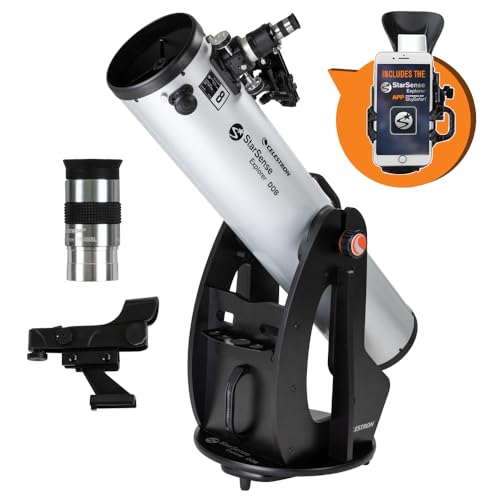
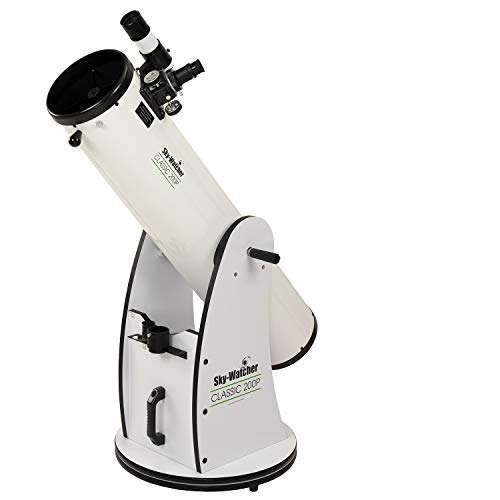
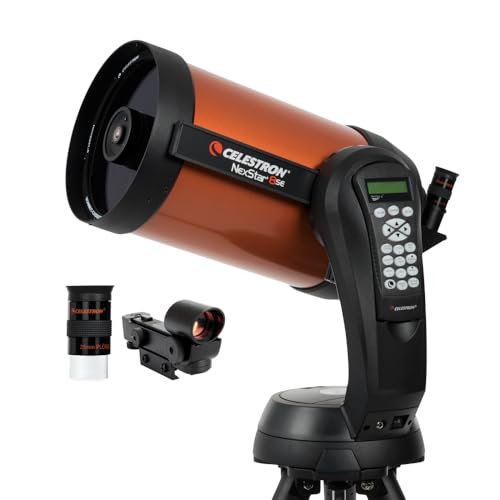
For galaxies and nebulae by eye, aperture and a dark sky matter most, so choose an 8-inch class telescope. The Celestron StarSense Explorer 8-inch Dobsonian adds phone-guided finding, the Sky-Watcher Classic 200P Dobsonian is the simple manual 8-inch, and the Celestron NexStar 8SE adds GoTo tracking in a compact tube.
Galaxies, nebulae and star clusters are called deep-sky objects, and they are the main reason many people buy a telescope. They are also the hardest targets to show well. They are faint, spread out and nothing like the glossy photographs. If your goal is to see them with your own eyes, the buying advice is different from a general beginner telescope. Three things dominate: aperture, a dark sky, and giving your eyes time to adapt.
We did not handle these telescopes ourselves. We compared the specs the manufacturers publish, and the general observing advice here is standard astronomy practice.
Aperture and Limiting Magnitude
Aperture is the diameter of the main mirror or lens. It collects light, and deep-sky observing is all about light. Makers often quote two numbers: “light gathering power” compared with the human eye, and “limiting magnitude,” the faintest star the telescope can show under good conditions. Both are calculated from aperture, and they are theoretical, not promises for your backyard.
Here are the manufacturers’ own figures from the pages we compared:
- Celestron StarSense Explorer 8-inch Dobsonian: 203 mm aperture, light gathering power of 841 times the human eye, and a limiting magnitude of 14.2, according to Celestron.
- Sky-Watcher Classic 200P: 200 mm aperture, and Sky-Watcher USA says it is 816 times brighter than the human eye and 78% brighter than its 150 mm model.
- Celestron Inspire 100AZ (for comparison): 100 mm aperture, 212 times the unaided eye, and a limiting magnitude of 12.5, according to Celestron.
A higher limiting magnitude means fainter stars, but a galaxy is not a point. It is a dim, extended glow, so sky brightness matters as much as the number. A telescope’s theoretical limit is reached only under dark skies.
Dark Skies Matter More Than Gear
Light pollution washes out extended objects. John Bortle published his nine-class scale in Sky & Telescope in 2001. According to the Wikipedia summary, a class 1 sky has a naked-eye limiting magnitude of about 7.6 to 8.0, with many Messier objects visible to the naked eye, while a class 5 suburban sky is about 5.6 to 6.0 and the Milky Way is washed out overhead. Class 9 is an inner-city sky where only the Moon, planets and a handful of bright clusters are visible.
The practical lesson: an 8-inch telescope under a class 3 or 4 sky shows more than the same scope in a bright suburb. If you can, drive to a dark site. Plan around the Moon, too. A bright Moon acts like a light-pollution source, so schedule deep-sky nights around the new Moon.
Dark Adaptation
Your eyes take time to become sensitive to faint light. A common rule is that good dark adaptation takes about 20 to 30 minutes, and a single glance at a white light can reset much of it. Use a red flashlight for charts and eyepiece changes, set your phone to night mode or red screen, and avoid looking at car headlights. Averted vision, looking slightly to the side of a faint object, uses the more light-sensitive part of your retina and often makes it pop.
Eyepieces for Deep Space
Magnification equals the telescope’s focal length divided by the eyepiece’s focal length. A telescope with a 1200 mm focal length and a 25 mm eyepiece gives 48x, which matches the kit eyepiece Celestron lists for the StarSense Explorer 8-inch Dobsonian.
- Low power (about 20 to 50x): large nebulae, big clusters, finding objects.
- Medium power (about 80 to 120x): small clusters, planetary nebulae, galaxy cores.
- High power: rarely needed for deep-sky; save it for the Moon, planets and double stars.
The upgrade that matters most is a good wide-field low-power eyepiece. Many Dobsonians accept 2-inch eyepieces, which show a wider field. According to Celestron, the StarSense Explorer 8-inch includes a 2-inch Crayford focuser with an adapter for 1.25-inch eyepieces, and Sky-Watcher USA lists a 2-inch Crayford-style focuser with a 1.25-inch adapter on the Classic 200P.
Our Picks for Deep-Sky Viewing
Celestron StarSense Explorer 8-inch Dobsonian
An 8-inch Dobsonian with phone-guided finding, so you can reach galaxies and nebulae without motors or a star-hopping learning curve.
Celestron lists a 203 mm f/5.9 Newtonian with a 1200 mm focal length and a 2-inch Crayford focuser on a manual Dobsonian base. The StarSense Explorer app guides you to targets using your phone’s camera. The total weight is 43.4 pounds in two pieces, according to Celestron. Be ready to cool and occasionally collimate the mirror. The StarSense Explorer 8-inch profile has the full specs.
Sky-Watcher Classic 200P Dobsonian
A traditional 8-inch solid-tube Dobsonian with no electronics. For observers who want the aperture and are happy to learn the sky.
According to Sky-Watcher USA, the Classic 200P has a 200 mm parabolic primary mirror made of borosilicate glass with a coating rated at 94% reflectivity, a rocker box with Teflon bearings and a tension-control handle, and includes two eyepieces and a 9x50 finderscope. There is no GoTo and no phone guidance. You find objects with a finder and a star chart or app. Details are in the Classic 200P profile.
Celestron NexStar 8SE
An 8-inch computerized Schmidt-Cassegrain that finds and tracks objects for you, in a shorter, more portable tube than an 8-inch Dobsonian.
According to Celestron, the 8SE has a 203.2 mm aperture, a 2032 mm focal length at f/10, a computerized single-fork-arm alt-azimuth mount with SkyAlign, and a 40,000-object database. The kit weighs 32 pounds in total. It gathers about the same light as the 8-inch Dobsonians, but its long focal length gives a narrower field, and the motors keep objects in view at high power. Eight AA batteries or a 12V power source are needed. See the NexStar 8SE profile.
Dobsonian vs NexStar 8SE
All three picks have the same 8-inch class aperture, so the question becomes how you want to find and follow objects.
- Dobsonian (Classic 200P or StarSense 8-inch): lowest cost per inch of aperture, wide field, no power needed. Big and bulky; you push the tube by hand.
- NexStar 8SE: GoTo and tracking, compact tube, but a narrower field of view and a more complicated setup with batteries.
If you want help finding things without motors, the StarSense app on the Dobsonian is a middle ground. If you want automation, the 8SE is the choice.
Smart Scopes vs Eyepiece Views
Smart telescopes, such as the Unistellar Odyssey and the Seestar S50 Pro, stack images in real time, so faint objects look much brighter on a screen than they do through an eyepiece. Unistellar lists a magnitude limit of 17.2 for the Odyssey, an 85 mm telescope. The trade-off is that you watch a screen, not the sky. If you want to see photons from a galaxy arrive in your own eye, a Dobsonian is a better choice. If you want a brighter, more detailed picture with less effort, a smart scope is simpler.
Solar Safety
If you ever point any of these telescopes at the Sun, use a full-aperture solar filter that meets ISO 12312-2 and is attached securely to the front of the telescope. According to the American Astronomical Society, never look at the Sun through an unfiltered telescope, binoculars or camera. A filter that threads onto an eyepiece is not safe. Check any filter for scratches before use.
How to Choose
- Simple and big: Sky-Watcher Classic 200P.
- Big with finding help: Celestron StarSense Explorer 8-inch Dobsonian.
- Big with motors: Celestron NexStar 8SE.
For all ten models ranked side by side, see our best telescopes of 2026 comparison. Whatever you pick, take it to the darkest sky you can reach and give your eyes half an hour.
Sources
Frequently asked questions
What size telescope do I need to see galaxies?
More aperture helps, and 8 inches (about 200 mm) is a popular threshold for adults who want clear views of galaxies and nebulae. Smaller telescopes still show the brightest ones, such as the Andromeda Galaxy and the Orion Nebula, but fainter objects need more light and a darker sky.
Will I see color in galaxies and nebulae through a telescope?
Mostly no. Your eyes cannot detect color at low light levels, so most deep-sky objects look gray or faintly greenish. Photographs, and smart telescopes that stack images, reveal the colors.
Is a Dobsonian better than a GoTo telescope for deep space?
For the money, usually yes: a Dobsonian puts more aperture in the tube. A GoTo telescope like the NexStar 8SE finds and tracks objects for you, which suits people who do not want to hunt by hand. A phone-guided Dobsonian like the StarSense Explorer 8-inch offers help finding without motors.
How long does it take for my eyes to adapt to the dark?
A common rule is about 20 to 30 minutes for good dark adaptation. Use a red light to read charts, and keep phone screens dim or in night mode, because white light resets your adaptation.
What eyepiece should I use for deep-sky objects?
Start with a low-power, wide-field eyepiece to find and frame large objects, then add a medium-power one for clusters and small nebulae. Your telescope's focal length and the eyepiece's focal length set the magnification: divide one by the other.
Can I observe the Sun with a deep-sky telescope?
Only with a proper solar filter that meets ISO 12312-2 and covers the entire front of the telescope. Never look at the Sun through an unfiltered telescope. The American Astronomical Society has a page on safe solar viewing.