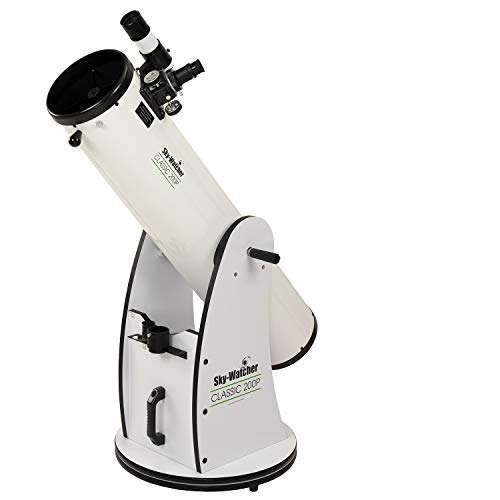
The Sky-Watcher Classic 200P is a Dobsonian telescope in the original sense: a large mirror in a simple tube, sitting on a plain rocker box that you push by hand. There is no computer, no motor and no app. It is the design that put big apertures within reach of ordinary amateur astronomers, and it remains one of the most direct ways to buy light-gathering power.
We did not handle this telescope. This profile organizes the specifications published by Sky-Watcher USA, adds general knowledge about what an 8-inch aperture shows, and notes where the maker’s page is silent so you know what to verify before buying.
Who It’s For
The Classic 200P suits people who want to see as much as possible and are happy to learn the sky the traditional way. Sky-Watcher itself says that using a star chart to find objects by hand can be more fulfilling than a computerized scope and will improve your knowledge of the night sky. If that appeals to you, this telescope is a good fit. It is also a smart choice for someone with a garage, a shed or a ground-floor closet who wants to spend money on optics rather than electronics.
It is a poor fit if you want the telescope to find objects for you, if you need something you can toss in a trunk and carry up stairs, or if photography is the goal. For automatic finding, see the Celestron NexStar 8SE. For phone-guided finding with the same aperture, see the Celestron StarSense Explorer 8-inch Dobsonian.
Key Specs According to Sky-Watcher
| Spec | Value |
|---|
| Optical design | Newtonian reflector with parabolic primary mirror |
| Aperture | 200 mm (8 inches) |
| Primary mirror | Borosilicate, Radiant Aluminum Quartz (RAQ) coating, 94% reflectivity |
| Light gathering | 816 times brighter than the human eye; 78% brighter than the 150 mm model |
| Mount | Manual Dobsonian rocker box with Teflon bearings and tension control handle |
| Focuser | 2-inch Crayford-style with 1.25-inch adapter |
| Included | Two 1.25-inch eyepieces, 1.25-inch adapter, 2-inch eyepiece adapter, dust caps, 9x50 finderscope |
| GoTo | None |
These values come from the Sky-Watcher USA product page, which does not list focal length, weight or eyepiece focal lengths. Check the current listing for those figures before you buy eyepieces.
Optics and What You Can Realistically See
Sky-Watcher describes Dobsonians as “light buckets”: they offer the largest aperture for the money compared with refractors or Schmidt-Cassegrains. The Classic 200P’s primary mirror is borosilicate with the RAQ coating, which the maker says reaches 94 percent reflectivity. The page says the 8-inch aperture makes the scope perfect for visual observation of faint objects such as nebulae, star clusters and galaxies.
From general knowledge of the 8-inch class, here is what that means in practice:
- The Moon: sharp, detailed views of craters, mountain ranges and rilles. It is very bright at this aperture, so a Moon filter or higher magnification makes viewing more comfortable.
- Planets: Jupiter’s cloud belts and its four largest moons are clear. Saturn’s rings and, on steady nights, the gap in the rings are within reach. Mars and Venus show small disks, though how much detail you see depends heavily on atmospheric steadiness.
- Star clusters: globular clusters like M13 begin to resolve into stars, and open clusters look rich.
- Nebulae and galaxies: the Orion Nebula and other bright nebulae show structure. Galaxies such as Andromeda and several in the Virgo and Leo regions are visible, and from dark skies you may glimpse spiral hints in brighter ones. As with any visual telescope, they appear as soft gray glows, not as colorful photographs.
A parabolic mirror avoids the spherical aberration that can soften images in cheaper mirrors. Because the mirror is large, results depend heavily on sky conditions. Newtonian reflectors need time to cool to outdoor temperature, and the mirrors occasionally need collimation, a small mechanical adjustment. Learn it early, because it is a normal part of owning this type of telescope. This is a visual instrument, not an astrophotography scope.
Mount and Finding Objects
The rocker box has Teflon bearings for smooth movement and a patented tension control handle that Sky-Watcher says allows precise slewing and stability. Because it is a pure alt-azimuth Dobsonian, you push the tube up and down and swing the base left and right. Objects drift through the field of view as Earth turns, and you nudge the tube to keep them centered. At low power, that is easy. At high power, nudging the tube becomes a routine you learn quickly.
There is no GoTo and no app guidance. You find things the old-fashioned way: the 9x50 finderscope helps you aim at a star pattern, and a star atlas or a planetarium app on your phone tells you where to point. This takes practice, and some people find it very rewarding. Others get frustrated in their first weeks, especially under light-polluted skies, where faint guide stars are hard to see. If that sounds like you, a phone-guided or computerized scope may keep you observing longer.
Setup, Weight and Portability
Sky-Watcher’s page does not publish a weight, but the design gives an idea of the scale: a solid 8-inch tube plus a rocker box. It is a two-piece telescope that most adults can move, though possibly in more than one trip, and it needs space to store. Check the current listing for exact weight and dimensions before you commit if stairs or limited storage are a concern.
Setup is quick: place the tube in the cradle, remove the dust caps, insert an eyepiece and aim. There is nothing to align, power or charge. The telescope is ready when you are, aside from cool-down time. That is a major reason many observers keep a Dobsonian around for casual evenings.
What’s in the Box and What You’ll Want to Add
According to Sky-Watcher USA, the telescope includes two 1.25-inch eyepieces, a 1.25-inch adapter, a 2-inch eyepiece adapter, dust caps and a 9x50 finderscope. The page does not list the eyepiece focal lengths, so check the listing for that detail. The package is basic, so expect to buy upgrades such as eyepieces and a better finder separately.
Common additions:
- Better eyepieces. One wide-field eyepiece and one or two higher-power options expand what the telescope can do.
- A collimation tool, such as a Cheshire eyepiece or a laser collimator.
- A red flashlight to keep your night vision.
- A star atlas or planetarium app for finding objects.
- A certified solar filter, only if you plan to observe the Sun. Never point any telescope at the Sun without a proper full-aperture solar filter (ISO 12312-2 compliant). None is included.
Pros and Cons
Pros
- Large 8-inch aperture with a parabolic mirror.
- Nothing to plug in, charge or align.
- Smooth, stable rocker box with tension control.
- A 2-inch focuser that accepts nearly any eyepiece.
Cons
- No GoTo, no phone guidance and no tracking.
- A bulky tube and base.
- Needs cooldown and occasional collimation.
- A basic accessory kit.
Alternatives on This Site
Verdict
The Classic 200P gives you the most aperture for the least complexity. It asks you to learn the sky, put up with a bulky tube and accept a basic accessory kit. In return you get a reliable, silent telescope with nothing to break. If you have storage space and enjoy finding things yourself, it is hard to beat. If you want the telescope to do the finding, choose a computerized or phone-guided model instead. See how it ranks against the other nine models in our best telescopes of 2026 comparison.
Sources
See the Sky-Watcher Classic 200P on Amazon