We earn a commission if you buy through our links, at no extra cost to you.
Best Telescope for Beginners (Adults): How to Choose
Buying a first telescope as an adult: aperture vs magnification, mounts, phone-guided finding, cooling, dark skies, first targets and solar safety.
At a glance
For a first telescope, the Celestron StarSense Explorer 8-inch Dobsonian gives the most aperture and phone-guided finding. The Celestron StarSense Explorer DX 130AZ is the lighter phone-guided choice, and the Sky-Watcher Heritage 150 is a compact tabletop Dobsonian. Aperture matters more than magnification.
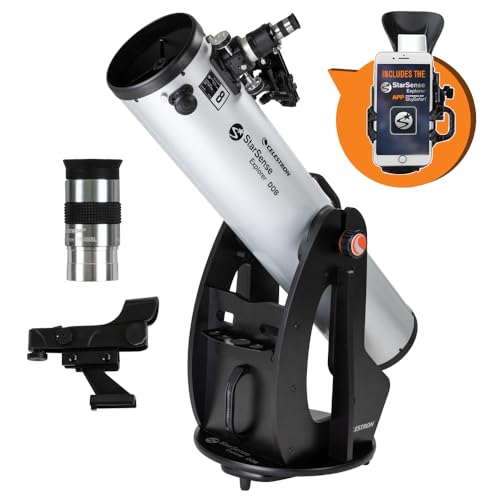
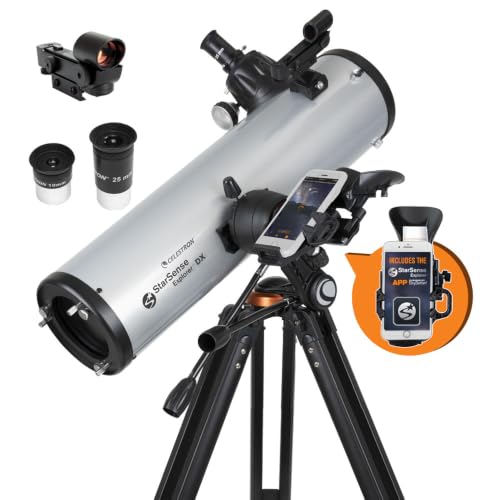
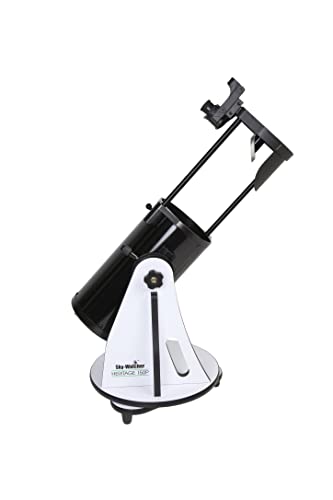
Most first telescopes end up in a closet. Not because astronomy is boring, but because the buyer picked the wrong kind of telescope: one that is too wobbly, too complicated to point, or sold on a magnification number that the optics could never deliver. If you are an adult buying your first telescope, the good news is that the decision is simpler than the marketing makes it look. Four things matter: aperture, a mount you can use without frustration, a way to find things, and a sky that is dark enough for what you want to see.
We did not handle these telescopes ourselves. This guide compares what the manufacturers publish and draws on well-established astronomy basics, and the spec figures below are the makers’ own.
Aperture Beats Magnification
Aperture is the diameter of the main lens or mirror. It sets how much light the telescope gathers and how much fine detail it can show. A bigger aperture means brighter, sharper views of everything faint, from the Orion Nebula to a distant globular cluster.
Magnification, by contrast, is easy to change: it depends on the focal length of the telescope divided by the focal length of the eyepiece. Any telescope can be pushed to a big number with a short eyepiece. The catch is that the image gets dimmer and softer as you do. A common rule of thumb says that useful magnification tops out at roughly 50x per inch of aperture under steady air, and many nights the air only supports half of that.
So ignore “525x power!” on a box. Look at the aperture in inches or millimeters, and treat the eyepieces as accessories you will add over time. Because light-gathering area grows with the square of the diameter, the differences add up quickly. From the makers’ numbers, an 8-inch (203 mm) mirror collects about 2.4 times the light of a 130 mm one, and about 4 times the light of a 100 mm one.
Pick a Mount You Will Actually Use
The mount decides whether the telescope gets used on a Tuesday night.
- Dobsonian: a simple rocker box that moves up and down and left and right. It gives you the most aperture for the money and the least fuss: no tripod to level, no counterweights, no batteries. The trade-off is size and weight.
- Manual alt-azimuth tripod: a lighter setup you aim by hand. It packs smaller, but a flimsy tripod makes the view shake each time you touch the focuser.
- Computerized GoTo alt-azimuth: motors find and track objects for you after a short alignment. Convenient, but heavier, needs power, and the scope costs more per inch of aperture.
- Equatorial mounts: track the sky with one motion, which matters for photography. They take more setup and learning, and we leave them for a second telescope.
If you will carry the telescope out of a second-floor apartment, portability may beat aperture. If you have a garage or a porch, go as big as you can lift.
Finding Things: Phone-Guided Scopes
Locating a faint object by hand takes practice, which is where many beginners stall. Celestron’s StarSense Explorer line addresses that with a smartphone dock and app. According to Celestron, the app uses the phone’s camera to recognize the stars overhead and then guides you to targets. You nudge the telescope by hand until the on-screen markers line up.
It is a useful middle ground for beginners who want to see galaxies and nebulae without learning a star chart first, and without paying for motors. Keep a power bank for the phone, because the screen and camera drain it faster in cold weather.
If you want hands-off tracking, a computerized GoTo scope or a smart telescope does the pointing with motors. We cover smart telescopes in our guide to astrophotography and in the Seestar S50 Pro profile; they trade eyepiece views for pictures on your phone.
Our Picks for a First Telescope
Celestron StarSense Explorer 8-inch Dobsonian
The most aperture in this guide, with phone-guided finding on a simple manual base. Best for an adult with room to store and carry a large tube.
According to Celestron, this is a 203 mm (8-inch) f/5.9 Newtonian with a 1200 mm focal length, a manual Dobsonian base and the StarSense Explorer app for sky recognition. It ships with a 25 mm eyepiece (48x), a 2-inch Crayford focuser and an eyepiece rack. Celestron lists a total weight of 43.4 pounds, split between a 20.6-pound tube and a 22.8-pound base, so it moves in two pieces. That weight is the main reason to hesitate. Read the full profile of the StarSense Explorer 8-inch Dobsonian for the details.
Celestron StarSense Explorer DX 130AZ
A lighter phone-guided telescope on a manual tripod. A good fit if the 8-inch is too big for your space or car.
Celestron lists a 130 mm (5.1-inch) f/5 Newtonian with a 650 mm focal length, on a manual alt-azimuth mount with 25 mm (26x) and 10 mm (65x) eyepieces. The total kit weight is 18 pounds. It gathers less light than an 8-inch, so faint galaxies look like smaller smudges, but it is far easier to carry and set up. Details are in the StarSense Explorer DX 130AZ profile.
Sky-Watcher Heritage 150
A compact tabletop Dobsonian with a collapsible tube, for small spaces and quick sessions. No phone guidance, so plan to learn the sky.
According to Sky-Watcher USA, the Heritage 150 has a 150 mm aperture, f/5 and a 750 mm focal length, with a collapsible tube that retains collimation and a tabletop design on rubber feet. Because it sits on a table, you need a stable surface such as a sturdy table, a picnic bench or a car hood. See the Heritage 150 profile for how it compares.
Celestron Inspire 100AZ
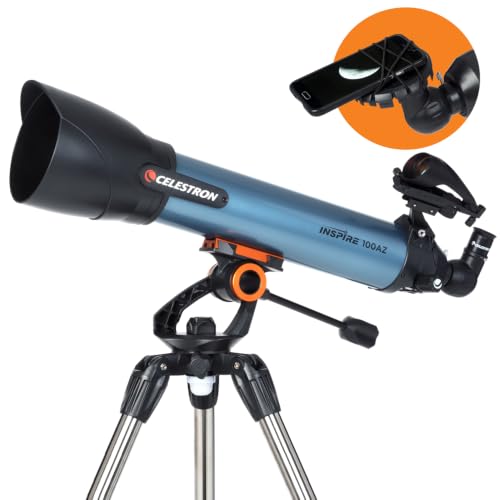
A 4-inch refractor on a manual tripod with an erect-image diagonal. Suited to the Moon, the planets and daytime scenery.
Celestron lists a 100 mm (3.9-inch) f/6.5 refractor with a 660 mm focal length and a 90-degree erect-image diagonal, which shows the view right-side up. A refractor has a sealed tube and rarely needs adjustment. It is the smallest aperture here, and Celestron’s own limiting magnitude figure is 12.5, so faint deep-sky objects are a stretch. Read the Inspire 100AZ profile.
Celestron NexStar 6SE
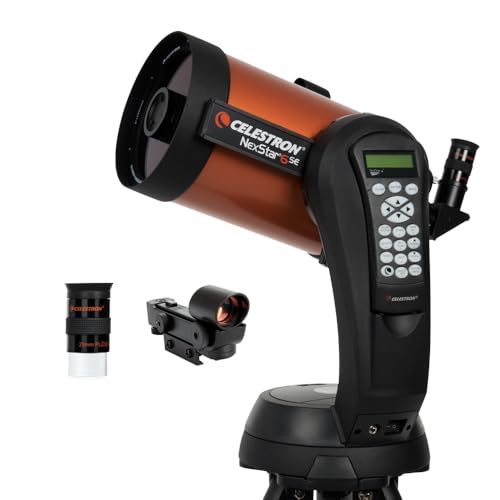
A computerized 6-inch Schmidt-Cassegrain that finds and tracks objects after alignment. For beginners who want motors.
According to Celestron, the 6SE has a 150 mm aperture, a 1500 mm focal length at f/10, a single-fork-arm computerized alt-azimuth mount, SkyAlign alignment and a 40,000-object database. The total kit weighs 28 pounds. The long focal length gives high magnification in a short, portable tube, and the motors do the finding. The NexStar 6SE profile has more.
Cooling and Collimation
Two maintenance habits come with reflectors and compound telescopes.
Cooling. A mirror or thick glass that is warmer than the night air creates currents in front of the optics, and stars look like boiling blobs. Set the telescope outside well before you observe. Big open-tube Dobsonians take the longest to settle.
Collimation. In a Newtonian reflector, the mirrors must line up with the eyepiece. They can drift after transport, and the fix is a simple adjustment with a collimation cap or laser. It takes a few minutes once you have done it. Sky-Watcher says the Heritage 150’s collapsible tube retains collimation, and a refractor like the Inspire 100AZ does not need adjustment in normal use. Check the instructions for your model before you touch any screws.
Light Pollution and the Bortle Scale
The sky you observe from matters nearly as much as the telescope. Amateur astronomer John Bortle published a nine-class scale in Sky & Telescope in 2001, and it is still the common shorthand. According to the Bortle scale summary on Wikipedia, a class 1 sky has a naked-eye limiting magnitude of about 7.6 to 8.0, while a suburban class 5 sky is about 5.6 to 6.0, and the Milky Way is washed out overhead. In an inner-city class 9 sky, little beyond the Moon, planets and a handful of the brightest clusters is visible.
What that means for you: a suburban backyard is fine for the Moon, planets, double stars and bright clusters. For galaxies and nebulae, drive to the darkest site you can reach. Even a one-hour drive can change what a given telescope shows.
First Targets
Start with objects that look good under any sky.
- The Moon: craters and mountains look sharp, especially along the terminator.
- Jupiter and Saturn: when they are up, Jupiter’s cloud bands and moons and Saturn’s rings are within reach of any scope on this list.
- The Pleiades and other open clusters: best at low power.
- The Orion Nebula (M42): the showpiece in winter.
- The Andromeda Galaxy (M31): a faint oval glow, better from a dark site.
Use low power to find an object, then step up the magnification to see more.
Solar Safety
Never look at the Sun through a telescope, binoculars or camera without a proper solar filter. According to the American Astronomical Society, filters should meet the ISO 12312-2 international standard, and any filter must be attached securely to the front of the telescope. Ordinary sunglasses are not safe, and unfiltered optics concentrate sunlight enough to damage your eyes in an instant. Skip any small filter that threads onto an eyepiece. Use a full-aperture filter made for your telescope, check it for scratches or pinholes before every use, and follow the maker’s instructions.
How to Choose
- Want the most for deep-sky and have room: the StarSense Explorer 8-inch Dobsonian.
- Want phone-guided finding in a smaller package: the StarSense Explorer DX 130AZ.
- Short on space: the Heritage 150 on a table, or the Inspire 100AZ on a tripod.
- Want motors and a compact tube: the NexStar 6SE.
To see all ten models we rank side by side, read our best telescopes of 2026 comparison. Whichever you choose, the best first telescope is the one you will carry outside on a cool, clear night.
Sources
- Celestron StarSense Explorer 8” Dobsonian official page
- Celestron StarSense Explorer DX 130AZ official page
- Celestron NexStar 6SE official page
- Celestron Inspire 100AZ official page
- Sky-Watcher USA Heritage 150 official page
- American Astronomical Society: eclipse and solar eye safety
- Bortle scale (Wikipedia)
Frequently asked questions
What is the best telescope for a beginner adult?
For most adults, a manual Dobsonian or a phone-guided manual scope. Aperture (the diameter of the main lens or mirror) matters most, and a simple mount means you spend more time looking and less time fighting the setup. The StarSense Explorer 8-inch Dobsonian is our pick if you have the space; the StarSense Explorer DX 130AZ is the more compact choice.
Is a telescope with a phone app worth it for beginners?
Finding objects is where most first-time owners give up. Celestron says the StarSense Explorer app uses your phone's camera to recognize the stars and guide you to targets, so you do not have to learn star-hopping before you see anything. You still move the telescope by hand, and you still need a phone with enough battery.
Does higher magnification mean a better telescope?
No. Magnification depends on the eyepiece you choose; what the telescope itself offers is aperture. Pushing the magnification past what the aperture and the air can support only gives a bigger, blurrier image. Most nights, low and medium power show more.
Can I use a telescope from my backyard in the suburbs?
Yes, for the Moon, the planets and many double stars and bright clusters. Faint galaxies and nebulae need darker skies. Light pollution is measured on the Bortle scale; a suburban sky is around class 5 and a rural sky around class 4 or darker.
How do I look at the Sun safely?
Only with a solar filter that meets the ISO 12312-2 standard and is attached securely to the front of the telescope, covering the full aperture. Never look at the Sun through an unfiltered telescope, binoculars or camera, and never use the small filter that screws into an eyepiece. The American Astronomical Society's eye-safety page explains the rules.
How long before a telescope is ready to use outside?
Reflectors and Schmidt-Cassegrains hold heat in their mirrors and glass, and images look soft until they cool toward the outdoor temperature. Setting the telescope outside 20 to 30 minutes before you observe is a common habit, and larger mirrors can take longer.